Field video: Samsung Business USA
Display hardware does not exist in isolation. A screen that performs well in one environment can fail completely in another — not because the hardware is defective, but because the environment imposes requirements that a generalist specification never anticipated. Setting is not background context for a display deployment. It is a primary design input, and treating it as such changes which questions get asked early enough to matter.
Retail environments present a specific combination of challenges: high ambient light, moving audiences, short dwell times, and content that changes frequently. Brightness requirements in retail are consistently underestimated during the planning phase. Overhead track lighting, skylights, and reflective surfaces can all conspire to wash out a display that looked compelling in a showroom demo. In retail, the screen that wins is the one that holds its image against whatever the lighting team has decided the floor needs to look like — and that decision is rarely made with displays in mind. Specifying display brightness against the finished lighting plan, not the architectural drawings, is a discipline that saves painful retrofits.
Dwell time in retail is short and variable. A customer walking past a screen in a main aisle may give it two seconds of peripheral attention. A customer waiting at a service counter may give it ninety seconds of direct attention. Content designed for the walking audience often fails the waiting audience, and vice versa. The better approach is to treat dwell zones differently — corridor placements carry short-form content optimized for motion viewing, while point-of-wait placements carry longer-form content that rewards sustained attention. This requires content strategy, not just hardware placement.
Healthcare settings impose requirements that do not appear in most commercial display specifications. Patient populations include people who are anxious, in pain, cognitively impaired, or accompanied by distressed family members. Content that reads as energetic and engaging in a retail context can feel aggressive and disorienting in a clinical waiting area. Brightness levels that draw attention in a lobby can be uncomfortable in a procedure waiting room where overhead lighting is already carefully managed. Many healthcare deployments also require content approval workflows that commercial content management systems are not designed for by default — clinical information, wayfinding updates, and patient communications each carry different review and compliance requirements.
Sound is a variable in healthcare that retail rarely has to navigate. In spaces where patients or family members may be receiving difficult information, ambient audio from nearby screens — even at low levels — is an intrusion. Healthcare display deployments often require closed captioning as a default, not an accommodation, because screens in those environments typically run silent. This affects content production requirements from the beginning of a project, not as a post-production adjustment.
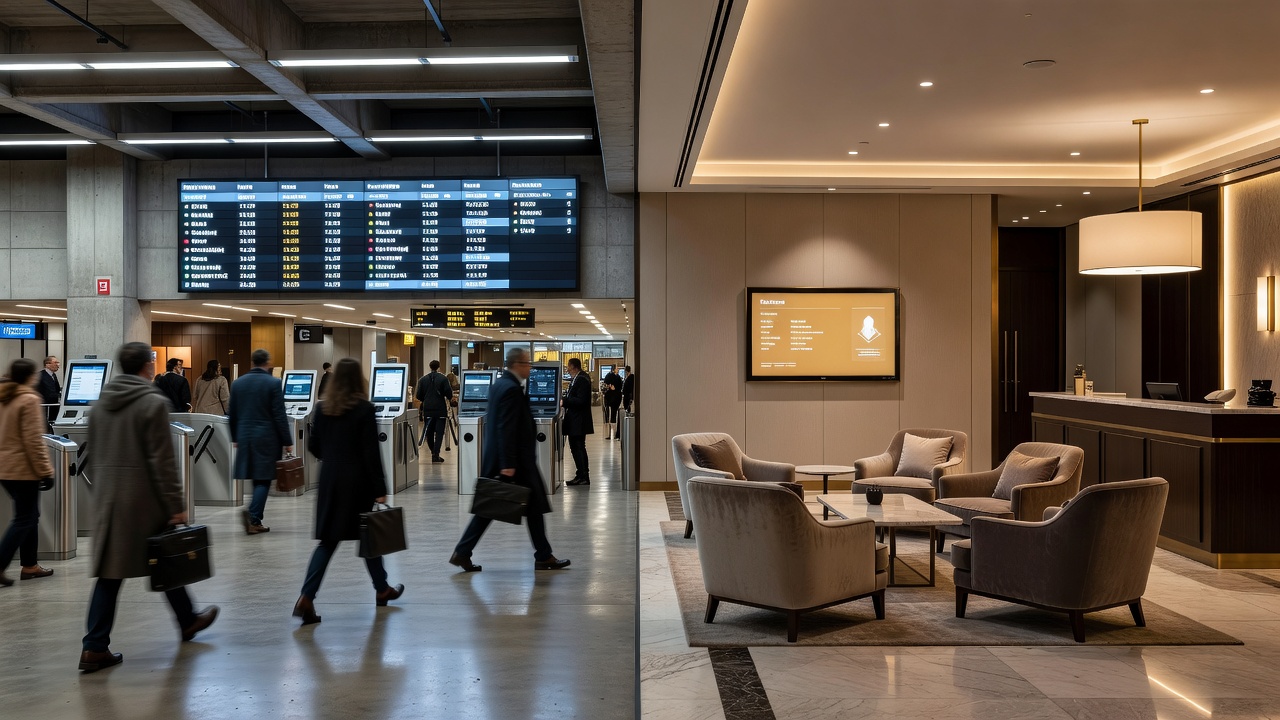
Transit environments — stations, terminals, platforms, covered stops — are among the most technically demanding settings for display deployments. Audiences are in motion, often under time pressure, and the information they need has genuine urgency. A departure board that is hard to read costs someone a train. Ambient conditions in transit settings vary enormously: underground stations have controlled but often dim lighting; covered platforms deal with daylight ingress at oblique angles; outdoor-exposed displays face full sun, temperature extremes, and precipitation. Hardware specifications for transit must account for the full range of conditions the installation will actually experience across all seasons, not the average condition.
Vandalism and physical interference are transit-specific concerns that affect hardware selection, mounting, and protective specification. Screens at platform level in high-traffic public transit see contact, deliberate interference, and cleaning regimes that commercial-grade hardware is not rated for. Enclosures, tempered glass overlays, and mounting hardware rated for public-environment use are not optional accessories in these settings — they are part of the baseline specification.
Hospitality environments — hotels, resorts, conference venues — operate across a wide range of deployment contexts within a single property. Lobby displays serve as brand expression and guest orientation simultaneously. In-room displays carry entirely different requirements around privacy, content control, and integration with property management systems. Conference and event space displays need to flex between generic property branding and per-event customization, often on short notice and managed by staff who are not AV specialists. The content management and scheduling infrastructure for a hospitality deployment has to accommodate all of these use patterns without requiring specialized technical intervention for routine changes.
Office environments have shifted considerably in their display requirements as hybrid and flexible work patterns have reshaped how buildings are used. Wayfinding and room booking displays now need to reflect real-time occupancy data rather than static schedules. Lobby and reception displays serve both employee communications and visitor-facing functions, which often have different content governance requirements. The audience in an office environment is more predictable than retail or transit — the same people encounter the same screens repeatedly — which changes how content fatigue is managed. Content that works at initial deployment can become invisible within weeks if it does not update in ways that the audience notices.
Across all settings, the most consistent finding from field deployments is that the installation environment changes between the planning phase and the commissioning date. Lighting plans shift. Furniture layouts move. Traffic patterns differ from what the architect modeled. Treating the specification as final before the environment is finished leads to displays that are correct for the drawing, not the room. Building in a commissioning phase that includes display adjustment after the environment is complete — not just after the hardware is installed — is the practice that consistently produces deployments that actually work.
For practitioners looking to go deeper on how environment shapes deployment decisions across specific settings, a setting-by-setting deployment reference covers the operational and technical considerations in more detail.
The broader context for all of this is covered under digital signage on Wikipedia, which maps the technology categories, network architectures, and industry segments that shape how setting-specific decisions get made.